From Content Guilt to Content Gold: The Psychological Transformation
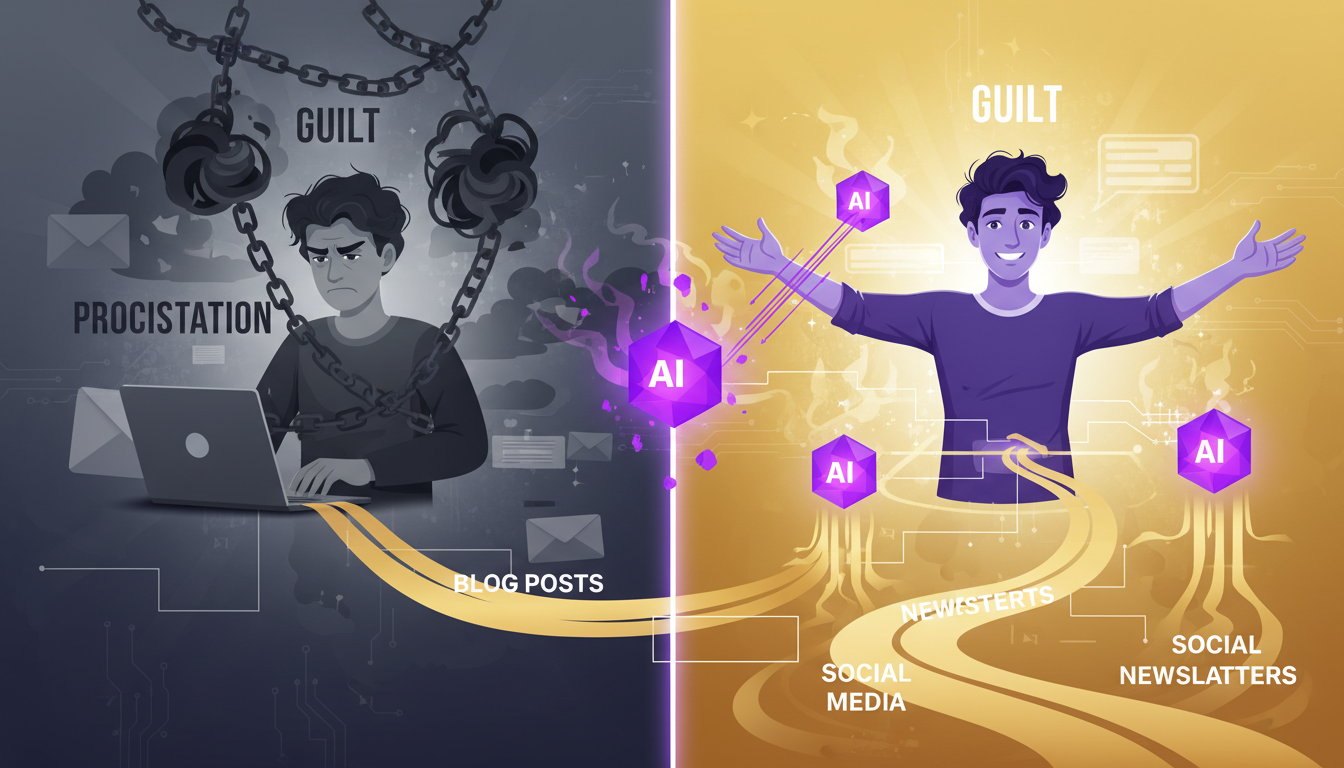
From Content Guilt to Content Gold: The Psychological Transformation
Every founder knows the feeling. It starts as a whisper in the back of your mind: "I should be blogging. I should be posting on LinkedIn. My competitors are outpublishing me 5:1." Then comes the crushing weight of content guilt—that psychological burden that keeps you staring at a blank document, paralyzed by the gap between knowing what you should do and actually doing it.
But here's what most founders don't realize: Studies show that about 68% of potential buyers back out of purchases because of guilt or ethical concerns. That same psychological force keeping customers from buying is keeping you from creating the content that could bring them to you.
The transformation from content guilt to content gold isn't just about productivity—it's about fundamentally rewiring how you think about content creation itself.
The Psychology Behind Content Guilt
Why Founders Feel Guilty About Content
Content guilt isn't laziness. It is a common problem among successful people to have an outsized fear of failure. Those who succeeded throughout school, university, and in their working life can feel as if their entire value is based on their performance. They think that if they make even one mistake, then they will be worthless as a person.
For founders, this manifests as:
- Perfectionism Paralysis: Every blog post feels like it needs to be a masterpiece
- Time Scarcity Guilt: "I could be building product instead of writing"
- Expertise Impostor Syndrome: "Who am I to teach others?"
- Consistency Shame: Starting and stopping content efforts repeatedly
Finally, the constant companion of most CEOs is a feeling of stress and guilt about not doing enough. However hard they work, there is always more than could be done, and this lack of a firm endpoint to their tasks will add to their stress. With so many other concerns to attend to, CEOs might feel that it is pointless or even self-indulgent to be reflecting and producing content.
The Decision Fatigue Factor
Content creation hits founders at their most vulnerable point: the end of the day when mental energy depletes after repeated decision-making, leading to impulsive choices, avoidance, or poor judgment. This state of mental exhaustion is commonly referred to by psychologists as ego depletion, which describes how our capacity to make sensible and thoughtful decisions declines over time.
"Decision Fatigue," is the mental exhaustion from making decisions and processing choices. Decision fatigue can wear people down, causing them to make impulsive decisions without carefully thinking through consequences, or it can cause them to do nothing due to the energy needed to weigh options.
Every content decision becomes another drain:
- What should I write about?
- Which platform should I post on?
- What tone should I use?
- When should I publish?
- How do I measure success?
Breaking Through Psychological Barriers
The Cognitive Load Problem
Research shows that 74% of consumers abandon their purchases because of feeling overwhelmed by information. There are several psychology-based explanations for this phenomenon. The human brain has a limited processing capacity, so when it's bombarded with marketing information over time, it becomes less able to interact with the new content.
The same principle applies to content creators. When you're bombarded with content decisions, your brain shuts down. The solution isn't willpower—it's systematic reduction of cognitive load.
The Automation Advantage
Here's where the psychological transformation begins: automation doesn't just save time, it removes decision points entirely. When AI agents handle the "what," "when," and "how" of content creation, your brain is free to focus on the "why"—the strategic vision only you can provide.
Automation is a game-changer in reducing decision fatigue. Tools like CRM systems, automated marketing platforms, and AI-driven analytics remove the need for repetitive decision-making. For example, instead of manually deciding which leads to follow up with, an AI tool can prioritise them based on conversion likelihood.
The Mindset Shift: From Burden to Asset
Reframing Content as Infrastructure
The most powerful psychological shift happens when you stop seeing content as "marketing tasks" and start seeing it as discoverability infrastructure. Your potential customers are searching for solutions right now. Content isn't self-promotion—it's being findable when it matters.
Gratitude is the practice of replacing guilt with awareness, and "I am not doing enough" with "I am doing something that matters." It helps us show up for each other when the wider world might make apathy seem like the easier choice.
From Creator to Curator
When AI agents produce content in your voice, your role transforms from creator to curator. You become the conductor of an orchestra, not the person playing every instrument. This shift removes the psychological weight of "doing it all" while maintaining authentic voice and strategic direction.
The Compound Effect Psychology
Moving the needle means working towards and completing tasks/projects/launches that will lead our businesses to succeed in the future. Content compounds. Every article published today becomes a search result tomorrow, a lead magnet next month, and social proof next year. Understanding this compound psychology transforms content from expense to investment.
Practical Strategies for Transformation
1. Batch Decision-Making
Try pre-deciding on certain things in advance. For instance, pick out your outfit the night before, set up automatic bill payments, plan your meals for the week ahead, or stick to a consistent morning routine. By cutting down on minor decisions, you can free up your brainpower for what matters.
Apply this to content:
- Decide your content themes quarterly
- Batch keyword research monthly
- Schedule content production sessions weekly
2. The "Good Enough" Standard
Many of us procrastinate because we fear not doing the task perfectly. This 'perfection paralysis' can halt progress before we've even begun.
Define "good enough" content standards:
- 80% quality, published beats 100% quality, never shipped
- Iteration over perfection
- Progress over polish
3. Systematic Automation
Many entrepreneurs streamline daily routines—like eating the same breakfast, wearing similar outfits, or automating recurring business processes. By creating systems and templates for repetitive tasks—such as onboarding employees, responding to standard customer inquiries, or approving expenses—you free up mental capacity. Decision-making energy is too valuable to waste on low-impact choices.
The Gold Standard: Content as Competitive Advantage
The founders who make this psychological transformation don't just overcome content guilt—they turn content into their primary competitive advantage. While competitors remain paralyzed by perfectionism, automated content engines produce consistent value, build authority, and generate inbound leads 24/7.
As we head into 2026, the digital marketing landscape will continue to evolve rapidly, but the core principles outlined here will remain vital. Small businesses that break the cycle of procrastination and invest in these strategies will find themselves more visible and credible online – and remember, in today's world attention is currency, and visibility equals credibility.
Making the Mental Switch
The transformation from content guilt to content gold isn't about working harder—it's about working differently. When you remove decision fatigue through automation, reframe content as infrastructure rather than tasks, and embrace "good enough" over perfect, content creation becomes sustainable, scalable, and strategic.
Your competitors are still stuck in content guilt, staring at blank documents and making excuses. While they procrastinate, your content engine is building the discovery infrastructure that turns strangers into customers.
The psychological transformation is simple: stop trying to be a content creator and start being a content curator. Let AI agents handle the production while you focus on the strategy, voice, and vision only you can provide.
Ready to transform your content guilt into content gold? Discover how Supramono's AI agents can remove the psychological barriers keeping you from consistent content creation. Your future customers are searching for you right now—make sure they can find you.

Supramono
24 AI agents that build your pipeline
24 AI agents that build your pipeline
Learn more about Supramono and get started today.
Visit Supramono